NVIDIA's Indic AI Data: What Teams Can Prepare Now
NVIDIA, IIT Madras and AI4Bharat outlined a forthcoming 2.8T-token Indic AI corpus and data pipeline. Here’s what small teams can assess before release.
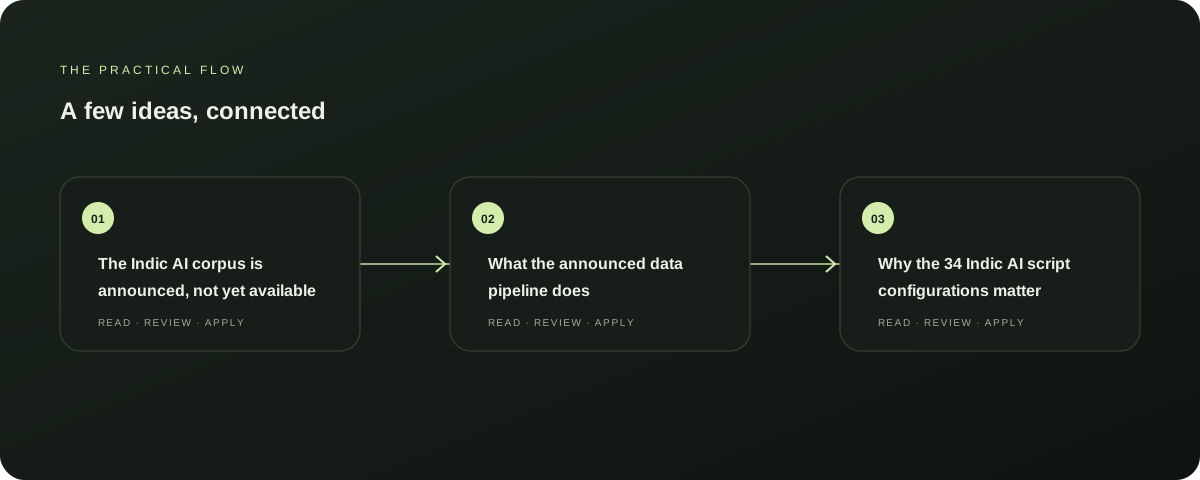
The Indic AI corpus is announced, not yet available
NVIDIA, IIT Madras and AI4Bharat describe Nemotron-pretraining-Indic-v1 as a forthcoming corpus of roughly 2.8 trillion tokens across 22 Indian languages. The source article says the data is releasing soon and shows how the collection is assembled; it does not present the corpus as a download available today.
Explore this section
Its inventory lists 2,601.0 billion native-script tokens and 224.6 billion romanized tokens. Counts use the Gemma-4 tokenizer and include translated records and script variants, so they should not be read as unique source documents or a model training budget. Further reading: Hugging Face: Scaling Indic Pretraining: 2.8 Trillion Tokens and an Open Data Generation Pipeline
What the announced data pipeline does
The accompanying post describes a GPU-accelerated process for translating curated English documents, assessing translation quality and repairing selected low-scoring outputs. It also explains that every generated record retains a source identifier so users can trace it back to its input.
Explore this section
The twelve-language workflow covers native-script and romanized data; the other ten use a separate translation workflow. These details make the announcement useful even before the corpus is downloadable: teams can assess the method, identify open questions and decide what evidence they would need before adopting similar synthetic-data workflows. Further reading: Hugging Face: Scaling Indic Pretraining: 2.8 Trillion Tokens and an Open Data Generation Pipeline
Why the 34 Indic AI script configurations matter
The announced corpus covers native scripts for all 22 languages and romanized text for twelve, for 34 language-script configurations. Romanized data here means an Indic language written in Latin script, not English translation.
Explore this section
The source notes that two script variants may represent the same underlying material, and that token counts include accepted rewrites. For a small team evaluating multilingual AI, this is a reminder to inspect language and script coverage separately.
A large aggregate token number alone does not tell you whether the target users, dialects or writing systems are represented well enough for your use case. Further reading: Hugging Face: Scaling Indic Pretraining: 2.8 Trillion Tokens and an Open Data Generation Pipeline
A practical evaluation plan for Indic AI teams
Before the announced release is available, write down the languages, scripts and tasks your product actually needs. When a dataset card is published, check its license, revision, provenance fields and available language splits.
Explore this section
Then sample records in the original and target scripts; include technical passages with equations, tables or code if those matter to your product. Compare a small training mixture at a fixed token budget and record what is natural text, translated synthetic text and romanized text.
These steps turn a promising announcement into an evaluation plan without assuming the corpus is already ready for production use. Further reading: Hugging Face: Scaling Indic Pretraining: 2.8 Trillion Tokens and an Open Data Generation Pipeline
Automated quality checks still need human review
The article describes quality scoring and targeted repair, and says sampled human reviews informed the workflow. It also cautions that coverage of human review varies across languages and that retained material can still contain errors.
Explore this section
A useful implementation keeps generated candidates separate from accepted data: sample by language and script, ask fluent reviewers to inspect meaning and tone, and track the reasons for rejection. If a source ID links records derived from the same document, keep related versions together when creating evaluation splits.
These checks help teams avoid mistaking processing traceability for semantic deduplication or a guarantee of quality. Further reading: Hugging Face: Scaling Indic Pretraining: 2.8 Trillion Tokens and an Open Data Generation Pipeline
What small teams can do next with Indic AI
Treat the announcement as a technical direction to monitor, not a package to deploy today. Follow the release, read its dataset card and license when available, and begin with a small evaluation set before changing a training pipeline.
Explore this section
Record model versions, source revisions and language-specific results so comparisons are reproducible. Relay’s view is that automation should remove repetitive preparation while keeping provenance, evaluation and human judgement visible.
That approach applies whether a team is considering multilingual training data or a more familiar content workflow: understand the inputs, test the result and keep a person responsible for the decision. Further reading: Hugging Face: Scaling Indic Pretraining: 2.8 Trillion Tokens and an Open Data Generation Pipeline
Prepared with Qwen from the sources linked throughout this guide. Follow the citations to review original material.
Sources & further reading
Explore the original guidance and research behind this article.
Explore the Relay apps
Compare AutoBox, AutoFeed and Apply.