AI and SEO: automate the research, not the usefulness
AI can help organise keyword research and editorial work. Google’s guidance draws a clear distinction between helpful content and search-first publishing.

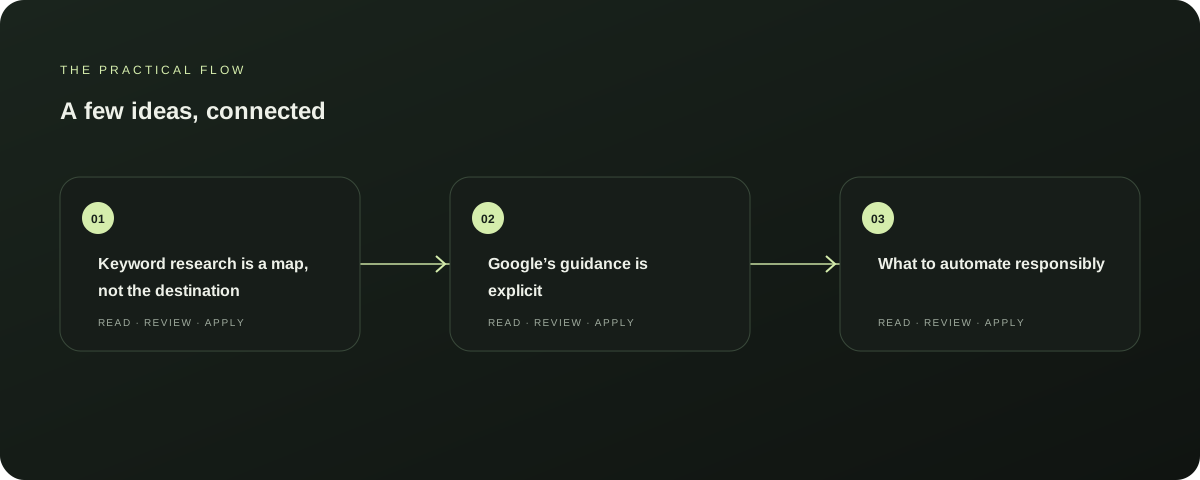
Keyword research is a map, not the destination
Search data can help identify the words people use and the questions they are trying to answer. It cannot tell you whether a draft is accurate, whether the page adds something worthwhile or whether you understand the subject.
Explore this section
Treat keyword signals as clues for reporting, not instructions to manufacture a page for every query. Further reading: Google people-first content guidance
Google’s guidance is explicit
Google Search Central recommends content created to help people, with original information, clear sourcing and enough depth to satisfy the reader. It cautions against producing many pages primarily to attract search visits and against summarising other sources without adding value.
Explore this section
Google also says there is no preferred word count. Read its people-first content guidance. Further reading: Google SEO Starter Guide
What to automate responsibly
Automation can collect candidate queries, group related questions, flag missing citations, check broken links and maintain a publishing checklist. It can highlight existing pages that might need a careful update.
Explore this section
These jobs reduce clerical work while keeping evidence and editorial judgement visible.
What still needs a person
An editor should verify claims against primary sources, decide whether a topic fits the publication, add first-hand knowledge and check that the article answers the reader’s question. An AI summary is not a substitute for reading the underlying source.
Explore this section
For a recent announcement, confirm the date and current status before publishing. Further reading: Google people-first content guidance
Make the article useful before polishing metadata
Write a descriptive title and page heading, use a clear URL and add accurate image descriptions. Link to primary sources and to the next useful page on your site.
Explore this section
Google’s SEO Starter Guide frames this work as helping search engines understand pages and helping people decide whether to visit; it does not promise a ranking. Google Search SEO Starter Guide. Further reading: Google people-first content guidance
A sensible AI-assisted editorial loop
Find a real question, research primary evidence, draft an answer with a clear point of view, review it for accuracy and usefulness, then make it easy to find. Search tools can inform the first step and help maintain the last.
Explore this section
The value comes from the reporting and care in between. Further reading: Google people-first content guidance
Sources & further reading
Explore the original guidance and research behind this article.
Put the idea into practice.
Explore AutoFeed, or take a look inside a sample workspace.